A top salesperson resigns. Or an operations lead. Or a senior engineer who's been with the company eight years. The team feels it immediately — not because of the contacts they took with them, or the title on their email signature, but because of something nobody wrote down.
Their judgment. Their instincts. The way they could read a room, a client, a production line, and know exactly what to do next. None of that was in a document. None of it was in a system. It just left.
Most companies respond the same way: post the job, hire a replacement, hope the new person gets there eventually. That gap — between when the knowledge walks out and when someone new rebuilds it — is where organizations quietly bleed performance.
What Companies Actually Lose When Top Performers Leave
When a top performer leaves, the CRM keeps their contacts. The SOP keeps their process. But neither captures how they actually thought.
The pattern recognition they built over years — knowing when a deal is cooling before anyone says so. The instinct that tells them this objection means "not yet," not "never." The timing — when to push, when to wait, when to loop in someone senior. The cross-functional shortcuts that let them move fast while others are still figuring out who to call.
None of this is documented anywhere. It was never meant to be. It accumulated quietly, conversation by conversation, over years of doing the work. And the moment they leave, it's gone — not to a competitor, not to a successor. Just gone.
That's what companies actually lose. And it compounds every time.
Why Traditional AI Tools Don't Solve This
Most enterprise AI deployments are built to answer questions — chatbots, knowledge bases, search tools layered on top of existing documentation. These are useful. But they capture what the company already knows explicitly. They don't capture how the best people actually think.
A chatbot can tell a new salesperson what the product costs. It can't tell them when a hesitating client is two conversations away from a yes. That distinction is the entire problem.
What Organizational Intelligence Actually Means
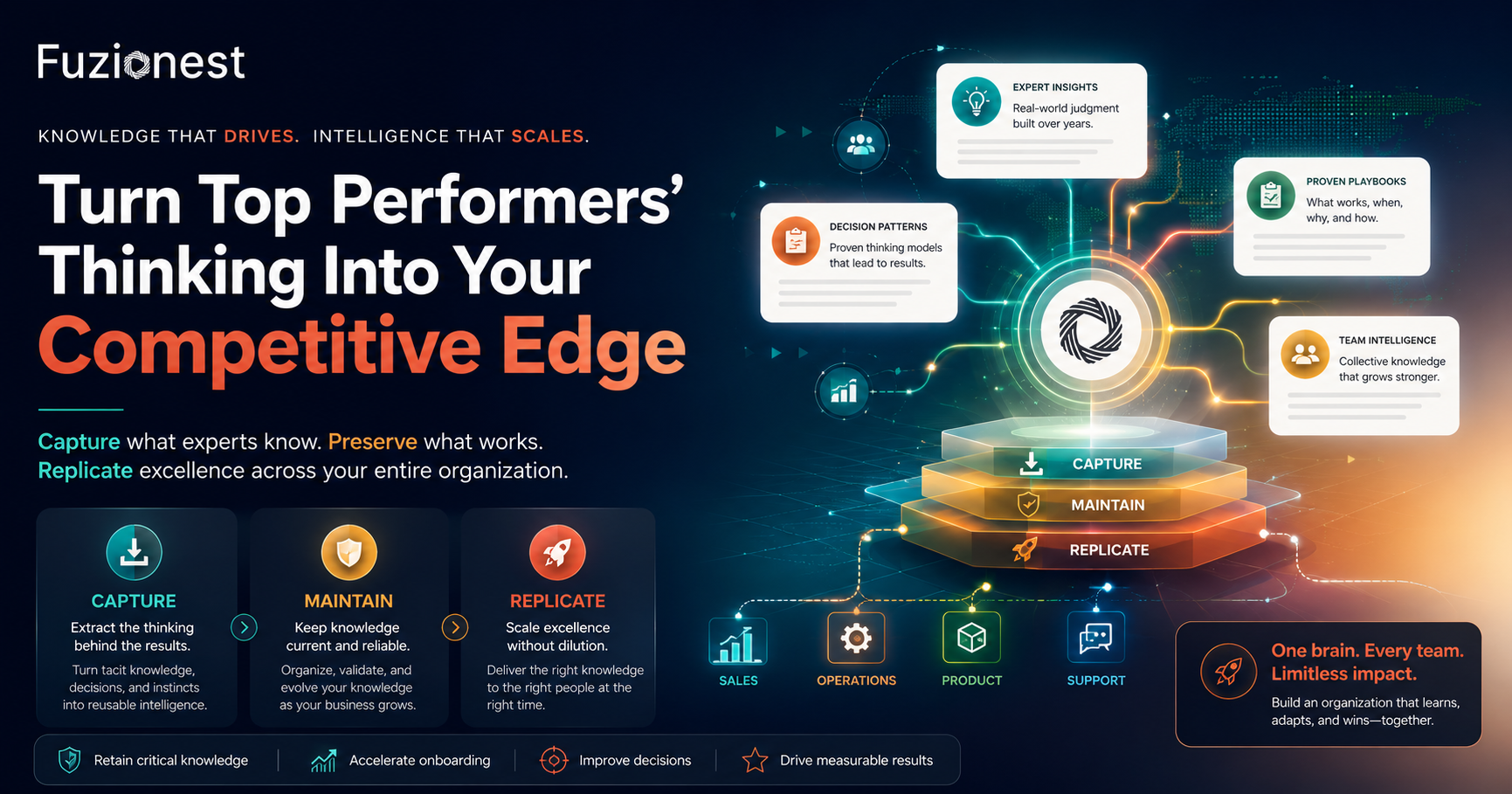
Organizational Intelligence is the practice of capturing, structuring, and distributing the tacit knowledge of top performers — so it can be replicated across the team through AI systems.
This isn't AI that replaces the top performer. It's AI that lets everyone else perform like them. We see this as three layers working together.
- Capture — structured capture of decisions, patterns, and reasoning from top performers, not just their outputs
- Maintain — keeping that knowledge current as the business, products, and market evolve
- Replicate — delivering it contextually to others at the exact moment they need it, through an AI companion, assistant, or guide
“The goal isn't AI that replaces your top performer. It's AI that lets everyone else perform like them.”
A Real Example
One of the clearest examples we've seen came from a manufacturing company with over 500 employees.
The problem wasn't that people didn't have access to information. It was that the quality of that information depended entirely on who you asked. New employees spent weeks figuring out who the "right person" was for each type of question. Cross-department requests got inconsistent answers. Shift changes meant knowledge gaps.
When they deployed an AI system built on Organizational Intelligence principles — capturing how experienced staff actually handled queries, not just what the manuals said — something shifted.
The speed improved. But the bigger change was consistency. Every employee, every shift, every department now got the same standard of guidance. The knowledge of the people who'd been there longest stopped being a privilege for those who knew who to ask.
That's what Organizational Intelligence looks like in practice. Not a demo. Not a pilot. A change in how knowledge moves through an organisation.
Where Enterprise AI Heading
The first wave of enterprise AI was about automation — doing things faster. The second wave is about intelligence replication — performing better, at scale.
Companies that figure out how to capture and distribute their best people's thinking will compound that advantage year over year. Those that don't will keep re-hiring and re-training every time a top performer walks out the door.
The question isn't whether AI can help your organization. It's whether you've identified what knowledge is most worth capturing first.
That's the conversation we're having with enterprise teams right now.
Talk to us about Organizational Intelligence →Continue Your Enterprise AI Transformation Journey
These insights on enterprise AI transformation, roadmaps, and project execution provide the foundational concepts behind organizational intelligence.
Organizational Intelligence — The Goldmine Hiding Inside Your Company
The 5-stage path to capturing how your best people think, and the value you bank at every step.
What Is Enterprise AI Transformation? The Complete 2026 Guide
The strategic overview and four pillars behind a successful transformation program.
Enterprise AI Transformation Roadmap: From Pilot to Scale
The five-phase execution plan for moving AI from pilot to production.
AI Readiness Assessment: Is Your Enterprise Ready to Deploy AI?
The readiness framework that identifies execution risks before implementation.
Why AI Transformation Projects Fail — And How to Succeed
The seven execution controls that help enterprises scale AI into real business value.