Three types of company exist right now.
Not two. Three. The middle group — the largest group — is the one most people in this room belong to. They are still in the race. The question is how much longer that remains true.
Artificial Intelligence is live, compounding, widening the competitive gap every month. The gap is already structural for their competitors.
Tried, hit the wall, some recovering with lessons. The window is still open — but it is not staying open.
Scrapped initiatives or never started. The gap is becoming structural. Each month it costs more to close.
“Which group are you in? More importantly — which group will you be in in twelve months? The answer is not determined by your current technology. It is determined by what you do in the upcoming days.”
The companies in Group One didn't get there by being bold. They got there by partnering with an AI transformation partner and building a scalable AI adoption strategy. The single most common thing that separates them from everyone else is not the technology they chose — it is their AI readiness framework. That starts with your data.
Before deploying enterprise AI solutions, your data must be honest.
Enterprise AI platforms do not fix data problems. They amplify them. An artificial intelligence solution trained on inconsistent data will find patterns in the inconsistency. It will do this confidently, at scale, and faster than any human could.
“Garbage in, garbage out is not a technical concern. It is a business risk. Artificial intelligence solutions will be wrong with the same confidence they are right — and your team will have no reliable way to tell the difference.”
Most enterprises carry some version of these foundational risks into their AI implementation services and organizational initiatives:
Company management data accumulated over years — inconsistent naming, duplicate entries, patchy history. The automated system reads all of it equally.
Duplicate customer records — same customer, four entries. The system can't know which is current. It treats all four as real.
Incomplete sales logs — sales representatives logging what they remember at the end of the week. The gaps are invisible until the system starts making recommendations.
Spreadsheets only one person understands — usually the person who has been there longest. Sometimes no longer there at all.
Disconnected systems — finance sees one version of the business, operations sees another, sales sees a third. The technology will try to reconcile what cannot be reconciled.
The companies that will succeed with AI workflow automation in 2027 started their data cleanup in 2025 — quietly, without announcing it. No press release. Just a disciplined decision to fix the foundation before deploying business automation with AI. The gap this creates is invisible until it isn't.
A clean data foundation is an essential part of an AI readiness framework. But it is not enough on its own. Even organisations with well-maintained data still experience AI adoption failure in remarkably consistent ways. Understanding these patterns is how you stop repeating them.
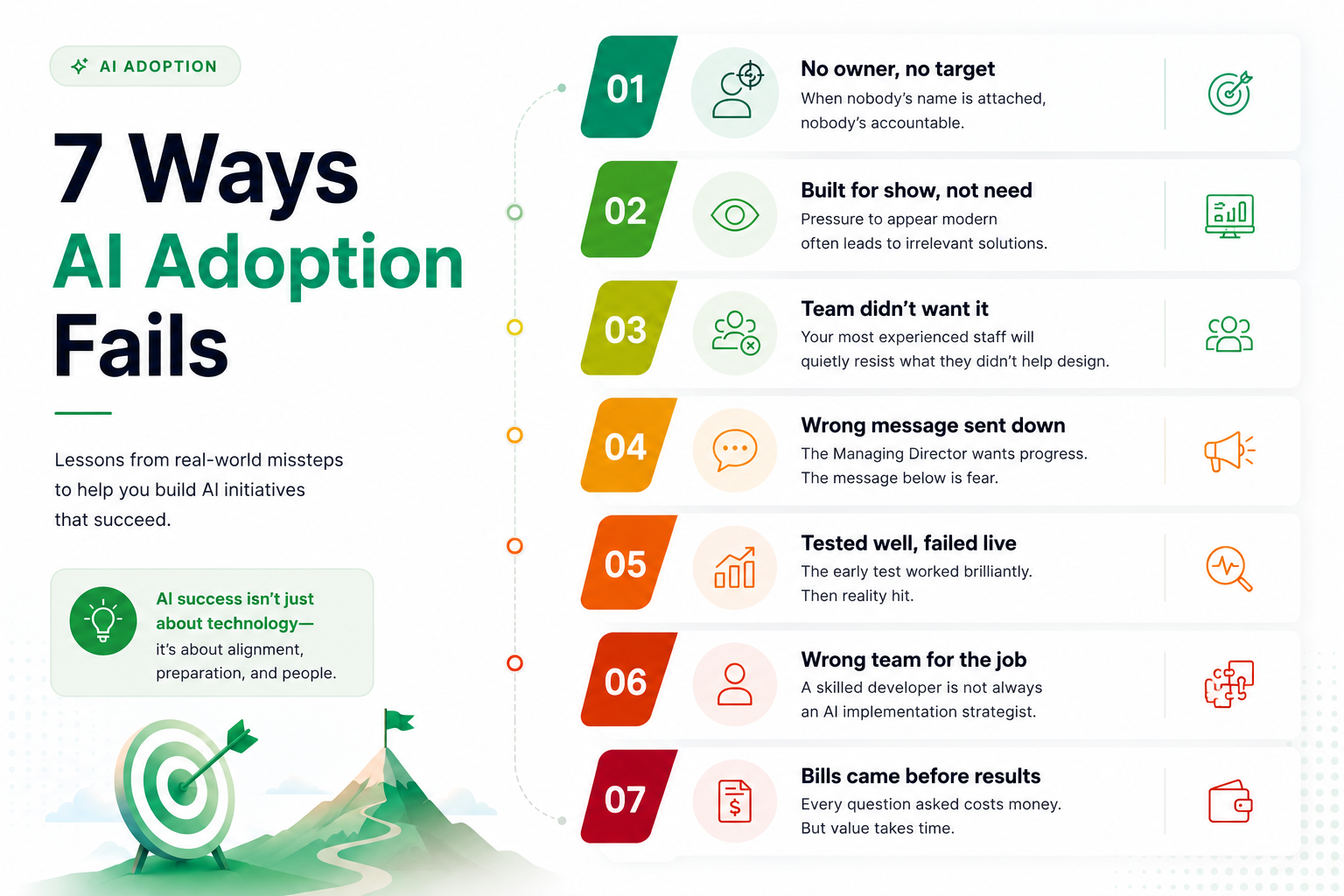
All seven pillars must hold. Remove one — your enterprise AI adoption fails.
These are not independent variables; they represent interconnected risks in your AI adoption strategy. Most companies fail at three or more simultaneously, which is why AI transformation failure is complex.
“Think of these as load-bearing floors in an AI readiness framework. Each one must hold the weight of everything above it. The strategy looks fine — until a foundational flaw collapses the entire project.”
Investing in enterprise AI platforms before proving business value
Traditional software has a predictable cost structure. Enterprise AI solutions do not. Every piece of data processed costs money. When the invoice arrives before any measurable financial return, finance teams intervene. The lack of an AI readiness framework to project ROI becomes a major bottleneck.
Project killed before value is realized. The sunk cost is written off as another AI implementation mistake, and the window closes.
Choosing traditional developers over an AI transformation partner
A skilled backend developer is not automatically equipped to build complex artificial intelligence solutions. The difference isn't visible in early demonstrations, but it surfaces when the enterprise AI platform scales. By then, technical debt has mounted.
Expensive rebuild or an AI business solution that technically works but cannot scale, leading to eventual AI adoption failure.
Pilots that ignore enterprise AI governance and security
The early AI workflow automation test worked in a sandbox. But moving it to real-world use without a strict AI readiness framework exposes it to live data and unpredictable security requirements. One data breach or hallucination is enough to destroy trust.
Trust in enterprise AI solutions is broken company-wide, setting back future business automation with AI for years.
Misaligned business goals and AI automation for business
The Managing Director wants strategic AI business solutions. It gets translated through management layers until developers build exactly what they thought was asked for. The result is perfectly engineered business automation with AI that solves the wrong problem.
Everyone did their job, but AI transformation failed. The initiative loses momentum because the AI adoption strategy was poorly communicated.
Why employee adoption matters in enterprise AI strategy
The people who know your business best often feel at risk from AI workflow automation. If an AI transformation partner isn't used to manage the human transition, employees quietly work around the system. The enterprise AI solutions are starved of the human data they need.
A technically functional AI platform that nobody uses. The executive sponsor loses confidence, causing silent AI adoption failure.
Buying complex artificial intelligence solutions for simple problems
Pressure to appear modern leads to buying expensive AI implementation services for tasks that simple software could handle. The goal becomes 'doing AI' rather than actual business automation with AI. This is expensive theatre rather than a genuine AI adoption strategy.
Wasted budget and exhausted organizational appetite, so when a real need for enterprise AI solutions arrives, there is no support.
Enterprise AI adoption fails without clear business ownership
Enterprise AI adoption fails when there is no clear business owner, success metric, or measurable AI adoption strategy. When success is defined simply as 'launching the tool' rather than improving a business result, the project drifts without accountability.
A project that could have succeeded drifts to its quiet end. The failure is recorded, but the real cause — a lack of clear AI consulting services and ownership — is not.
Reading through seven failure patterns is uncomfortable. But understanding these AI implementation mistakes is the first step in building a resilient AI adoption strategy.
When should a business work with an AI transformation partner?
The answer is before you buy the technology. Building a successful AI adoption strategy requires more than just tools. It requires a clear vision for AI workflow automation. As an enterprise AI solutions provider and AI implementation services company, Fuzionest helps organizations bridge the gap. Explore our enterprise AI platform or see how we act as your AI automation and workflow intelligence partner.
What's Next
Part 2: Where Does Your Organisation Actually Stand?
An AI readiness framework — not a sales pitch. Part 2 gives you a structured way to assess exactly where your organisation is across the five dimensions that determine whether enterprise AI adoption succeeds or fails.
No scoring system that ends with a product recommendation. No capability maturity model that requires a consultant to interpret. A set of honest questions you can answer in a room with your leadership team — and come out of knowing where to focus your AI adoption strategy first.
The Honest Artificial Intelligence Series
Frequently Asked Questions
Enterprise AI adoption is the strategic integration of artificial intelligence solutions into a company's operations. It goes beyond buying a tool; it requires a clear AI adoption strategy, a solid data foundation, and alignment with business goals to ensure measurable ROI.
AI projects fail because organizations often deploy an enterprise AI platform before establishing an AI readiness framework. Common causes include a lack of clear business ownership, poor data quality, misaligned business goals, and failing to manage employee adoption.
An AI readiness framework is a structured method to evaluate an organization's preparedness for enterprise AI solutions. It assesses data maturity, governance, employee skills, and leadership alignment before beginning any AI implementation services.
Common AI implementation mistakes include investing in technology before proving business value, choosing traditional developers over an AI transformation partner, ignoring security protocols, and buying complex AI business solutions for simple problems.
Companies can avoid AI adoption failure by securing executive ownership, establishing clean data prerequisites, prioritizing employee adoption, and developing a practical AI adoption strategy before executing business automation with AI.
A business should engage an AI transformation partner at the strategic planning phase, before purchasing enterprise AI solutions. A partner provides the necessary AI consulting services to assess readiness, build a secure architecture, and ensure the technology drives measurable value.